
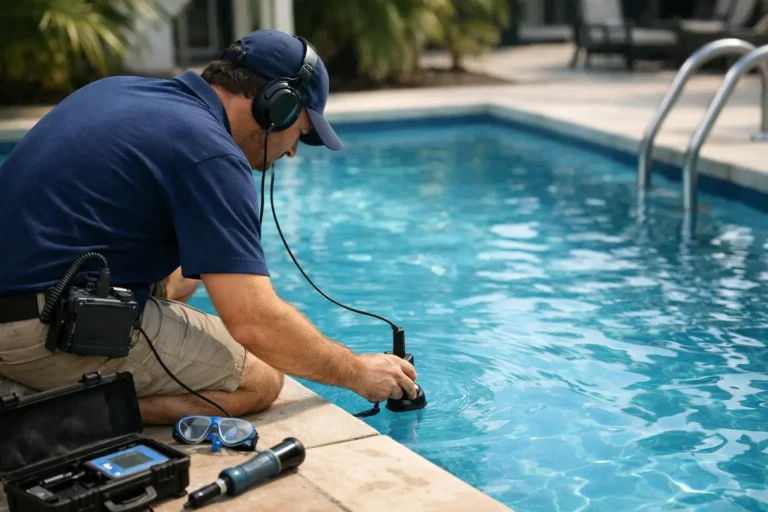
A pool that keeps losing water can turn into a guessing game fast. One day you are topping it off and assuming it is just heat or splash-out. A few days later, the water is down again, your chemical balance is off, and you start wondering if the problem is bigger than it looks. If you are asking how long does pool leak detection take, the honest answer is usually a few hours for the inspection itself, but the full timeline depends on where the leak is and how easy it is to confirm.
For most residential pools, leak detection can often be completed in one visit. In many cases, the testing process takes between 2 and 4 hours. That said, not every leak is straightforward. A simple plumbing leak near the equipment pad may be identified relatively quickly, while a structural leak in the shell, spa, light niche, or underground line can take longer to isolate.
The short version is this: many standard leak detection appointments take a half day or less. If the leak is active, accessible, and showing clear signs, a trained technician can usually narrow down the source during the visit. Homeowners are often relieved to hear that the process is methodical, not random. A good leak detection service does not just start tearing things apart. It starts by ruling out the obvious and testing the pool system in a logical order.
That timing can change if your pool has more than one issue at once. It is not unusual for an older pool to have both a plumbing leak and a separate surface crack, or for water loss to be partly caused by normal evaporation and partly caused by a hidden leak. When there are multiple possible causes, testing takes longer because each area has to be checked carefully.
Pool leak detection is usually a step-by-step process. The technician will first look at the pool, spa, equipment, and surrounding area for visible warning signs. Cracks, loose fittings, wet soil, air in the pump system, dropping water levels, and staining near penetrations can all point the inspection in the right direction.
From there, testing may include a bucket test to compare evaporation against actual water loss, dye testing around fittings and cracks, pressure testing of plumbing lines, and checking equipment connections. If the water level has been consistently stopping at the same point, that clue matters too. It can help identify whether the leak is likely in the tile line, skimmer, return, light, or another fixed area.
Some leaks reveal themselves quickly. Others require the technician to isolate lines one by one. If your pool has attached features like a spa, waterfalls, fountains, or autofill components, those can add time because they create more possible leak points.
The biggest factor is location. If a leak is in an accessible fitting or near the equipment, it is often faster to identify. If it is underground, behind a wall, or connected to multiple lines, finding the exact source takes more work.
Pool design matters too. A simple pool with basic plumbing is generally easier to test than a pool with a spa spillway, water features, multiple suction and return lines, and older repairs. More features mean more places where leaks can develop and more components that have to be isolated.
Age also plays a role. Older pools sometimes have worn seals, brittle plumbing, cracked plaster, settling around the shell, or patched areas that have changed over time. In that situation, the leak detection process is not just about finding one failure. It is about making sure the true source is identified so the repair actually solves the problem.
Weather and pool conditions can affect timing as well. Heavy debris, poor visibility, very low water level, or equipment that is already shut down can slow things down. If the water is cloudy, certain tests may be harder to perform accurately. Clean, stable conditions usually help the process move faster.
When plumbing lines need to be pressure tested, the appointment may move toward the longer end of the range. Pressure testing takes time because each line may need to be plugged, isolated, and monitored. If a line does not hold pressure, the next step is figuring out where along that run the leak is most likely located.
That does not always mean major excavation right away. A skilled technician will usually work to narrow the issue down before any repair plan is recommended. Still, plumbing leaks are often the reason one pool takes 2 hours to diagnose and another takes most of the day.
If you have noticed air bubbles in the returns, trouble priming the pump, or water loss that changes depending on whether the system is running, that can point toward a plumbing-related problem. Those patterns give useful clues, but they still need proper testing to confirm them.
One reason homeowners get confused about timing is that leak detection and leak repair are not the same appointment in every case. Finding the leak may take a few hours. Repairing it could be much quicker or could require scheduling additional work.
For example, replacing a bad seal, tightening a fitting, or making a minor repair around a light niche may be relatively simple. A broken underground line, structural crack, or damaged skimmer throat is a different story. Those repairs may require parts, surface prep, cure time, deck access, or coordination with other pool work.
This is why clear communication matters. A dependable pool company should explain what was tested, what was found, and what the next step looks like. Homeowners do not just want an answer. They want confidence that the right issue was identified and that the repair approach makes sense.
A lot of pool owners wait because they hope the problem is just evaporation. In Southern California, hot weather absolutely causes water loss, but a true leak usually leaves a pattern. If you are adding water more than expected, seeing soggy soil, noticing cracks, or watching your pool chemicals drift faster than normal, it is worth having it checked.
Delaying leak detection can make the final repair more expensive. Ongoing water loss can affect plaster, decking, equipment performance, and even the soil supporting the pool structure. A small leak is easier to deal with before it turns into a bigger repair project.
If your water level keeps dropping to the same spot, your autofill seems to run constantly, or your water bill has jumped without another clear reason, those are all good reasons to act. Fast action does not just save water. It can protect the pool itself.
You do not need to diagnose the leak yourself, but a little information helps. Pay attention to how often you are adding water, whether the loss seems worse with the system on or off, and whether the water level settles at a certain point. If you have seen wet spots, cracking, or equipment changes, mention those details.
It also helps to keep the pool accessible and avoid overfilling it right before the visit unless you are asked to do so. The existing water level can provide important clues. The more accurate the starting conditions, the easier it is to test efficiently.
Leak detection is not a job for guesswork. The process should be handled by a company that understands both pool systems and pool repair, because finding the leak is only part of the equation. You also want a team that can explain the result clearly and recommend the right fix without sending you in circles.
That is especially important for homeowners who want one reliable provider for ongoing pool care, equipment issues, structural repairs, and renovation work. When the same company understands how your pool operates as a whole, the advice is usually more practical and the repair plan is easier to trust.
At Valdez Pool Service and Repair, that hands-on experience matters because leak issues do not always stay isolated for long. A hidden leak can affect water chemistry, equipment strain, surface condition, and long-term pool value if it is ignored.
So, how long does pool leak detection take? In many cases, just a few hours. But the better question is whether the source is being identified carefully enough to prevent more damage later. A good inspection should leave you with answers, a clear path forward, and one less thing to worry about every time you look at the water level.