
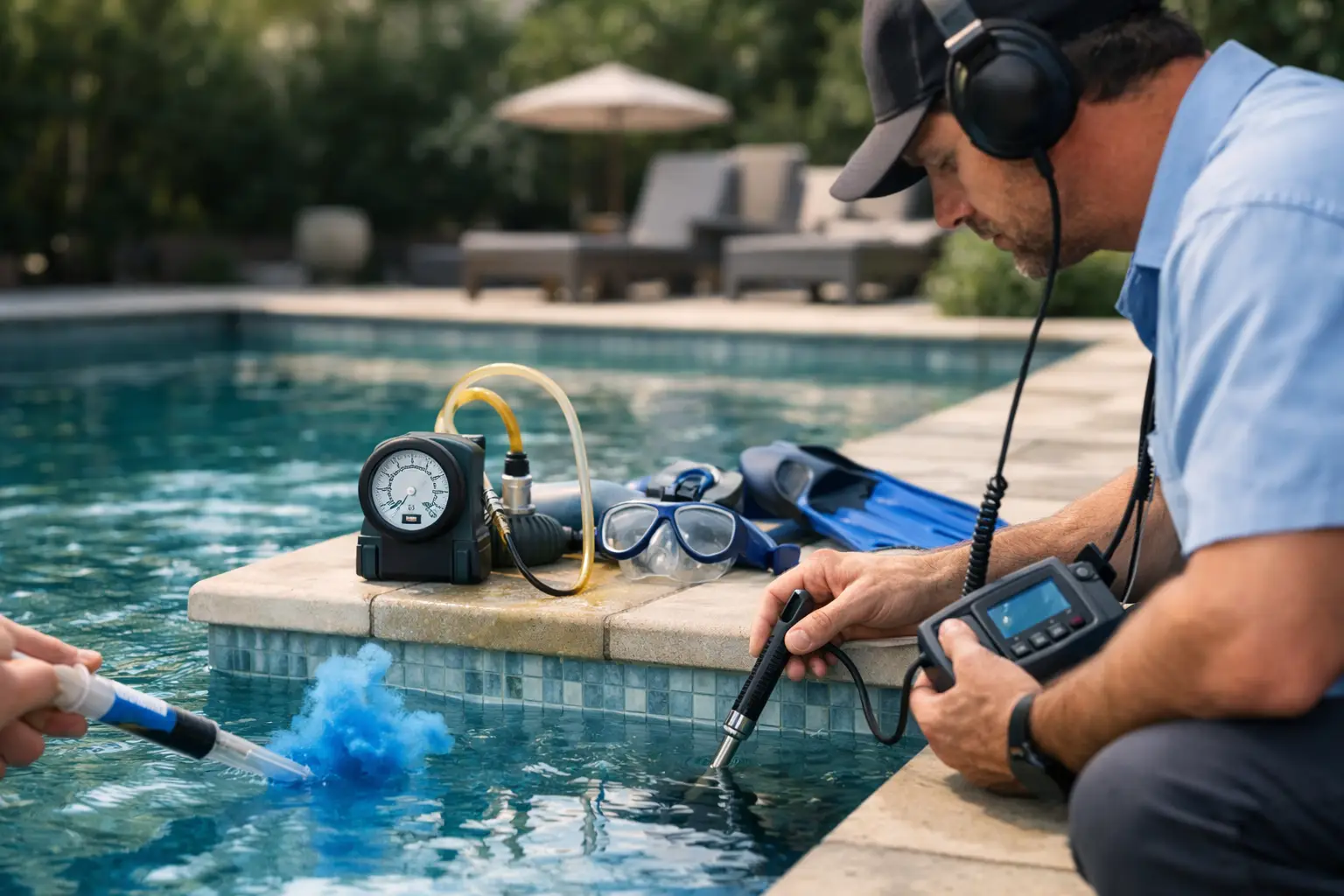
A pool that keeps losing water can get expensive fast. One week it looks like normal evaporation, and the next you are adding water again, noticing damp spots in the yard, or seeing your waterline drop below where it should be. If you have ever wondered how does pool leak detection work, the short answer is that it combines observation, pressure testing, dye testing, and specialized tools to pinpoint where water is escaping.
The key word is pinpoint. Leak detection is not just confirming that a pool has a leak. It is about finding the exact source so the repair is done correctly the first time. For homeowners, that matters because guessing can lead to unnecessary digging, wasted repair costs, and more damage to the pool shell, deck, or surrounding soil.
Professional pool leak detection usually starts with a process of elimination. Pools can lose water from the structure itself, the plumbing lines, the skimmer, the light niche, the main drain, return fittings, or the equipment pad. A good technician works through each possibility in a logical order instead of jumping straight to repairs.
The first step is often confirming whether the water loss is actually a leak. In Southern California, evaporation is real, especially during hot, dry stretches. Wind, sun exposure, water temperature, and how often the pool is used all affect water loss. A pool owner may think there is a leak when the issue is simply seasonal evaporation. On the other hand, a small leak can hide for weeks because it looks like normal water loss at first.
One of the most common ways to separate evaporation from leakage is the bucket test. A bucket filled to match the pool water level is placed on a pool step, then both levels are compared after a day or two with the pump on and sometimes again with the pump off. If the pool loses more water than the bucket, that suggests a leak. It is simple, but it gives useful direction before more advanced testing begins.
Once a leak is suspected, the inspection moves to the most common trouble spots. The pool shell is one possibility, especially if there are visible cracks, hollow spots, failing plaster, or movement around fittings. Vinyl and fiberglass pools have their own patterns, but in many residential in-ground pools, leaks often show up around penetrations where plumbing or fixtures pass through the shell.
The skimmer is a frequent problem area because it sits where the deck, pool shell, and plumbing all meet. Small separations can form there over time. Pool lights are another common source. The conduit behind the light niche can allow water to escape, and leaks around the light housing are not unusual.
Then there is the plumbing system. Suction lines, return lines, cleaner lines, and spa lines can all develop leaks underground. Equipment at the pad also deserves attention. A leaking pump seal, filter clamp, valve, or heater connection may not look dramatic, but over time it can waste a lot of water and create other problems.
One of the most recognized leak detection methods is dye testing. This is usually done with the pool water still and the pump off. A technician releases a small amount of dye near a suspected crack, fitting, or seam. If there is an active leak, the dye gets pulled toward the opening.
This method is especially helpful around skimmers, return fittings, main drain covers, cracks in plaster, and light niches. It sounds simple, and in some cases it is. But it still takes experience. Water movement, poor visibility, and surface condition can make results harder to read. A false assumption here can send the repair in the wrong direction.
That is why visual inspection matters just as much as the test itself. An experienced technician is looking for clues like calcium trails, softened soil, loose decking, algae growth in unusual spots, air in the pump basket, or cracks that suggest movement rather than cosmetic surface wear.
If the leak appears to be in the plumbing, pressure testing is one of the most important parts of the process. The line being tested is isolated and sealed, then air or water pressure is introduced to see whether it holds. If pressure drops, there is likely a leak somewhere in that line.
This step helps narrow the issue to a specific section of plumbing instead of treating the whole system as one unknown problem. For example, a return line may fail the test while the suction line holds, or a spa line may be the only one losing pressure. That saves time and avoids unnecessary excavation.
Pressure testing is useful, but it is not the whole story. It can tell you a line is leaking, but not always the exact point of failure. That is where listening equipment and location tools may come into play.
Professional leak detection often uses specialized acoustic equipment designed to hear water or air escaping from underground plumbing. Once a line is pressurized, a technician can listen for the sound of the leak through the deck or soil. This makes it easier to locate the break with much more accuracy.
In some cases, technicians may also use tracing methods or other tools to confirm the route of the pipe and narrow the repair area. The goal is to avoid guesswork. Homeowners usually care less about the technical name of the equipment and more about what it means for the job – less unnecessary demolition, faster diagnosis, and a cleaner repair plan.
Still, leak detection is not always perfectly straightforward. Soil conditions, pipe depth, nearby noise, and the age of the pool can all affect how easy the leak is to locate. Some leaks are obvious. Others take a more methodical process.
A good technician will also pay attention to whether the pool loses more water with the system running or with it off. That clue can say a lot.
If water loss increases when the pump is on, the problem may be on the pressure side, such as a return line, filter connection, or equipment fitting. If the pool loses more water when the pump is off, the leak could be on the suction side or in the shell itself. That is not a hard rule in every case, but it is a useful diagnostic pattern.
This is also why homeowners should avoid assuming every leak is underground. Sometimes the issue is right at the equipment pad, where a small but steady leak can be overlooked because water evaporates or drains away before it forms a large puddle.
When people ask how does pool leak detection work, what they often really want to know is why it cannot just be patched quickly. The reason is simple. Different leaks require different repairs, and the wrong fix usually means the problem comes back.
A crack in plaster may need sealing or structural evaluation depending on what caused it. A broken underground return line may require a spot repair or partial reroute. A leaking skimmer throat may need a targeted bond and seal repair. A light niche issue may involve sealing, conduit work, or fixture replacement.
If the diagnosis is wrong, you can spend money fixing the symptom instead of the cause. That is why experienced leak detection is worth it. It protects the pool, the deck, and the larger investment in the property.
Not every leak starts with a dramatic drop in water level. Sometimes the warning signs are smaller. You may notice the auto-fill running more often, wet soil near the pool, higher water bills, air entering the circulation system, loose or sinking deck areas, or new cracks around the skimmer.
Water loss can also create secondary issues. Low water can damage equipment if the pump runs dry or starts pulling air. Saturated soil can affect decking or place pressure on parts of the pool structure. In severe cases, a leak left alone long enough can lead to much more expensive repairs than the original problem.
For homeowners in areas like Moreno Valley, Riverside, Perris, Nuevo, San Jacinto, and Hemet, heat and dry weather can make it harder to judge what is normal water loss and what is not. That makes a careful inspection even more valuable.
You do not need to diagnose the leak yourself, but a few observations can help. Note how quickly the water level drops, whether it stops at a certain point, and whether loss changes when the system is on or off. Check around the equipment pad for visible drips or wet spots. Look for soft soil, deck movement, or cracks around fittings.
That said, there is a limit to what a homeowner should test alone. Pressurizing lines, diving around fittings, or attempting structural patch work without a clear diagnosis can create bigger issues. Pools are complex systems, and leak detection works best when the testing is systematic.
At Valdez Pool Service and Repair, the goal is to help homeowners understand what is happening, identify the actual source, and recommend the repair that fits the problem. That kind of clarity matters when you are trying to protect both your pool and your budget.
If your pool seems to lose water faster than it should, trust what you are seeing and get it checked before a small leak turns into a much bigger repair.